Growing up, mornings looked a certain way—almost ritualistic.
People gathered at bus stops and familiar street corners, those informal community huddle points where time slowed just enough for conversation. Parents dropped their children at schools, colleges, coaching centers, and tutorials. Traffic felt busy, but not chaotic—two‑wheelers, bicycles, buses packed with office‑goers, and only a handful of cars. Children walked to school, bags bouncing against their backs, laughter trailing behind them.
- The streets wore uniforms.
- Light and dark blues of ECIL.
- White and grey of DAE.
- Mornings had a dress code—and a discipline filled with purpose.
Noise levels were high, yes—but softened by human warmth. Conversations, shared jokes, sleepy smiles, and the collective excitement of starting the day together. Trees lined the roads, offering shade and a sense of freshness. The air felt lighter, the mood hopeful. Everyone was out there, in their own way, trying to build a better tomorrow—for themselves and for those who depended on them.
Then… fast‑forward a couple of decades.
What has changed?
The hustle remains. The urgency hasn’t faded. People are still going somewhere, chasing something. But the way we move through mornings has quietly transformed.
Now I see people waiting—not for buses, but for cabs and corporate shuttles. Parents drop their children at nodal points, carefully timed handovers to pickup vans. Blue jeans have replaced uniforms. Gen‑Z fashion dominates the sidewalks. Colorful ID tags hang from necks, announcing affiliations instead of institutions. Buses are filled with college students and a hi‑tech workforce heading toward Gachibowli, the Financial District, and beyond.
The noise has multiplied—engines, horns, construction—but it barely registers. Most ears are sealed behind ANC headphones. Minds are elsewhere, immersed in Spotify playlists and Instagram reels. The world exists, but only in the background, noticed mainly through smartphone notifications.
There is more shade now, but not from trees. It comes from towering concrete and glass structures. Cooler streets, yes—but at the cost of rising AQI levels. The vibe is still there, perhaps even amplified, but it has shifted—from physical presence to virtual connection.
And yet…
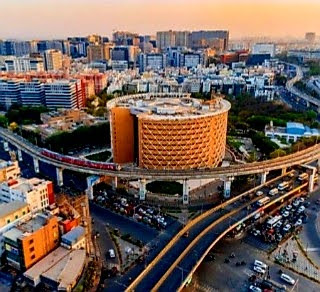
I must confess, I found myself quietly mesmerized passing through this surreal city.
The graceful arc of the Durgam Cheruvu cable bridge.
The restless glow of Hi‑Tech City waking up.
Glass high‑rises catching the early sun.
Serpent‑like flyovers carrying thousands of dreams, seamlessly.
These were once scenes we associated with postcards from the US or Europe. Today, they rise confidently in Hyderabad. Even visitors from so‑called “first‑world” cities pause here—look up, slow down, and marvel at what this city has built.
It leaves me with mixed emotions.
A longing for the warmth of yesterday.
A deep respect for the ambition of today.
As Hyderabad races ahead—faster roads, taller buildings, smarter lives—I sometimes wonder:
in our quest to build a global city, are we still carrying forward the gentle humanity that once defined our mornings?
Or perhaps real progress lies in learning how to pause—just for a moment—remove our earphones, look around, and remember that a city isn’t only made of flyovers and fiber cables… it’s made of people, passing each other every morning, carrying stories that still deserve to be noticed.